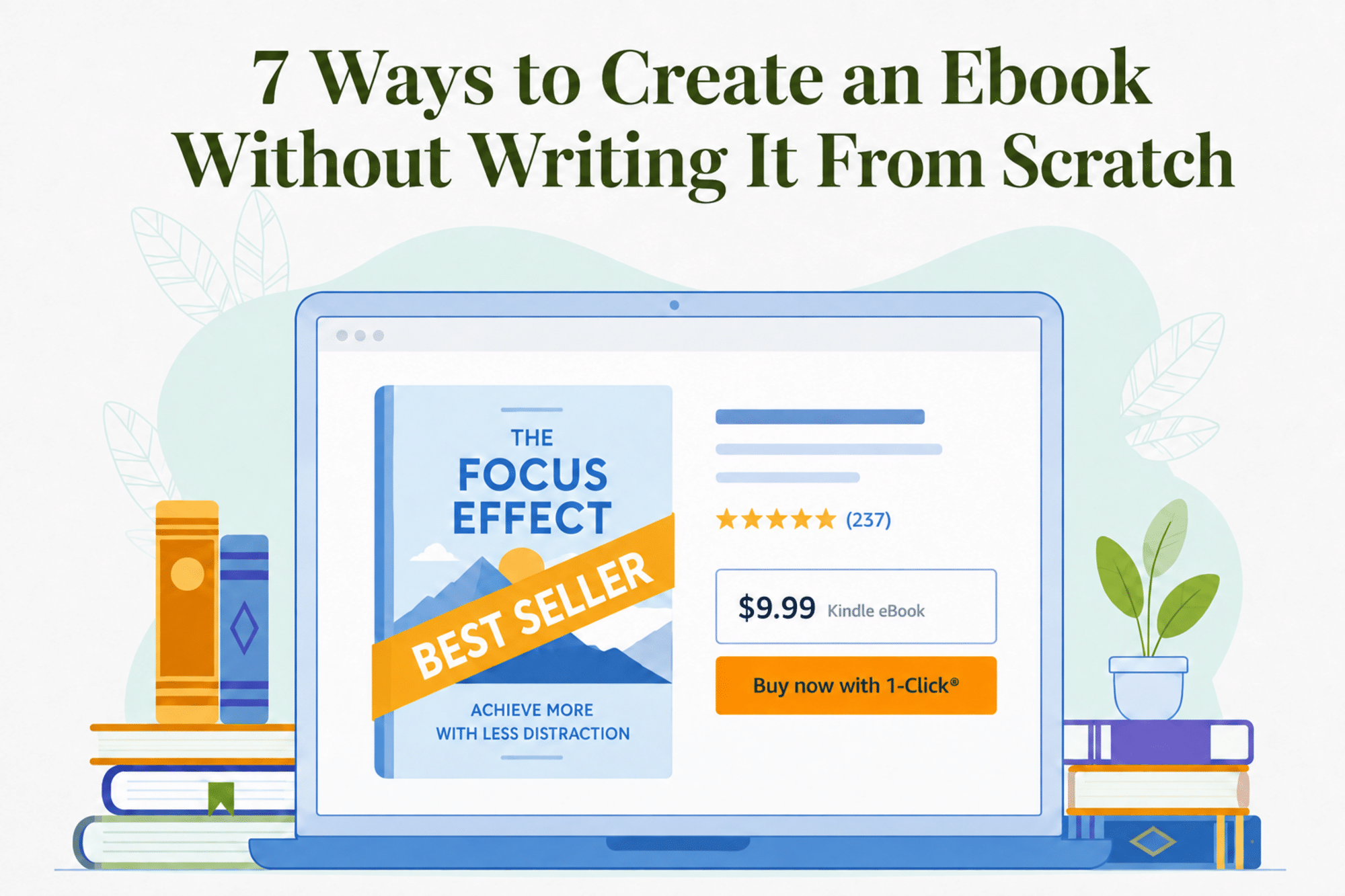
For many people, the idea of creating a book sounds amazing. And the thought of earning passive income from your books on Amazon, Etsy or your own site is a dream come true.
There's just one problem: You don't want to sit down and write the whole thing from a blank page.
Actually, that's not a problem at all!
Even if writing isn't your strength, you don't have time to research, organize and draft a book, or all you have is a scrap pile of half-finished notes, you can still create an impressive book.
That's because you don't have to create an ebook the traditional way. You need a useful idea, accurate information and a finished product that's worth reading. But you don't have to handle every part of the entire process alone—or begin from scratch.
You can create an ebook without writing it from beginning to end all by yourself. The seven methods below show you how to write an ebook by interviewing an expert, repurposing existing content, co-creating with AI, speaking your ideas, adapting a training, using licensed PLR content or hiring a writer.
#1: Interview Someone
Instead of becoming the subject-matter expert, take the role of a journalist. Interview someone whose knowledge, experience or story would interest your audience, then use that conversation to create an ebook.
This works especially well when the interview focuses on one defined problem. For example, rather than asking a successful Etsy seller to explain everything she knows about Etsy, you might interview her about how she plans seasonal product collections. A narrow topic makes the conversation easier to organize and the finished ebook more useful.
There are two simple ways to collect the content:
- Send your questions in a shared Google Doc or by email. Your guest's written responses become the raw material for the book.
- Record a conversation using Zoom, Google Meet or another recording service, then have the audio or video transcribed.
Before the interview, create a loose outline and group your questions by topic. During the conversation, listen for places where readers may need an example, clarification or step-by-step explanation. Those are your follow-up questions.
Once the interview is transcribed (I like Descript for this because it gives you one hour of free time per month), remove false starts and repeated information. Then reorganize the conversation into chapters or sections, and add an introduction and conclusion. AI can help clean up the transcript, suggest an outline and point out gaps. You should, however, review the finished material for accuracy and make sure it reflects what your guest intended to say.
#2: Turn Existing Content Into an Ebook
This is one of my favorite methods because you may already have most of the material you need.
Look through content you've created for:
If the thought of trying to write an ebook has kept you from getting started, stop assuming you must do every part the traditional way. Choose the approach that fits how you naturally work, gather the material you already have and begin creating one section at a time.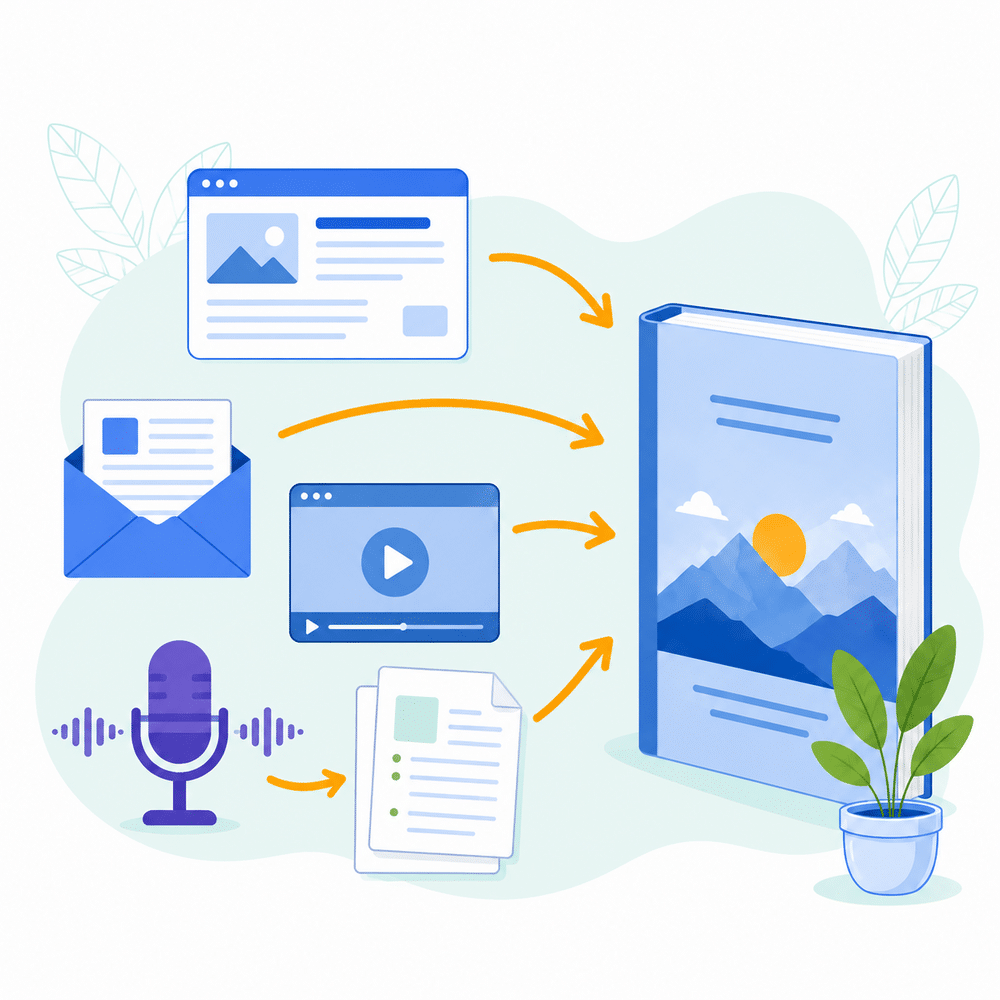
- Blog posts
- Emails sent to your list
- Articles and guest posts
- Video or podcast transcripts
- Social media posts
- Workshop notes and handouts
- Answers you've given customers
- Other educational content
Then:
- Remove duplication
- Arrange the material in a logical order
- Update outdated information
- Fill in missing steps
- Add transitions so the book reads as one connected resource
For instance, five blog posts about isolated email-marketing tactics could become a short guide when you organize them into a sequence:
- Choosing an offer
- Planning the emails
- Writing the messages
- Sending the campaign
- Measuring the results.
Once your content is organized, Designrr can help with production. You can import published blog posts straight from your blog using the link, Word documents or Google Docs, then choose a gorgeous cover and coordinate the interior design.
After the content is imported and formatted, you can edit the individual elements before publishing the ebook as a PDF or flipbook.
Watch a Designrr demonstration here.
#3: Co-Create Ebooks With AI
AI gives you far more options than typing one prompt and asking it to write an ebook from beginning to end. A better approach is to treat ChatGPT as a collaborator that works through the process with you.
Depending on what you enjoy and where you need help, ChatGPT can serve as your idea partner, research assistant, organizer, co-writer or editor. It can help you:
- Explore possible topics and narrow a broad idea into a useful short ebook
- Define the audience and the specific problem the book will solve
- Research questions, concerns and subtopics that readers will expect you to address
- Organize the information into a sensible outline
- Draft one chapter or section at a time
- Develop examples, explanations, transitions and action steps
- Review the complete draft for gaps, repetition and confusing passages
You also get to decide how the work is divided. You may supply the ideas and examples while AI drafts the wording. You might write a rough draft and ask ChatGPT to improve or expand it. Or you may have ChatGPT handle most of the initial drafting while you add your experience, opinions, stories and personal voice.
Whatever method you choose, don't publish the first draft untouched. Check facts and sources, remove generic filler, add information that only you can contribute, and edit the book until it sounds natural and delivers the result you promised the reader.
This collaborative approach is the process I teach in AI Book Quickstart: Partner With ChatGPT to Co-Create Short Books That Sell. [Get $20 off with code BOOKS at checkout.]
I walk you through partnering with ChatGPT to brainstorm, research, outline and draft a useful short, how-to ebook—while letting you decide how much of the writing you want AI to handle.
If you plan to publish through a marketplace, check its current rules before uploading your book. Amazon KDP currently requires publishers to disclose AI-generated text, images or translations. It doesn't require disclosure when AI only assisted you and you created the content yourself. Because platform rules can change, review the current policy when you're ready to publish.
Review Amazon KDP's current AI content guidelines.
#4: Speak Your Ebook
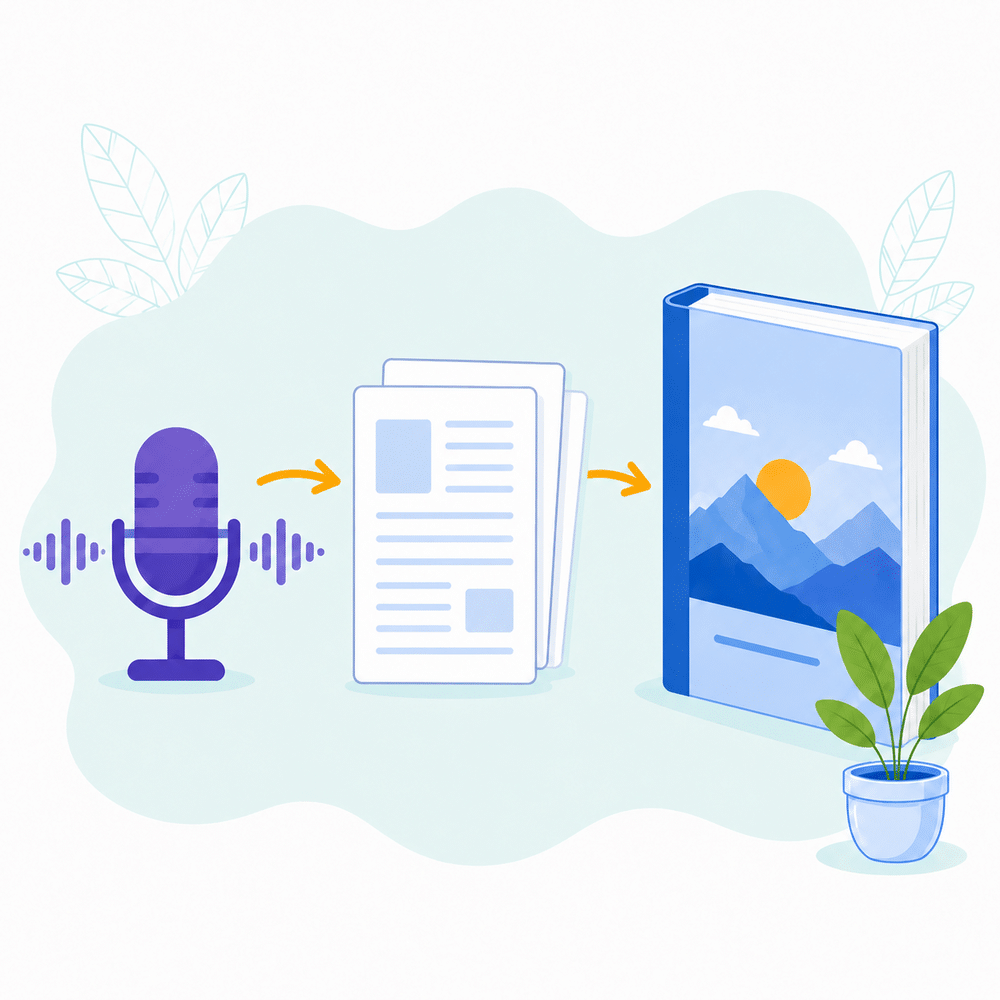
Some people can explain a topic easily in conversation but freeze when they try to write an ebook. If that sounds familiar, just speak your ebook.
Begin with a simple outline for the entire book. Then create three to five talking points for each chapter or section. Record one section at a time so you don't have to deliver the whole book perfectly in one sitting.
Talk as though you're explaining the subject to a customer, student or friend. If you make a mistake, pause and begin that sentence again. You can remove the unwanted portion later.
After the recording is transcribed, turn the spoken material into readable text. Spoken conversations usually contain repetition, filler words, unfinished sentences and ideas that arrive out of order. Edit those out while preserving the relaxed, natural voice that made speaking easier in the first place.
AI can speed up this stage considerably. Give it one section of the transcript at a time and ask it to organize the material, remove verbal clutter and improve readability without changing your meaning or personality. Then compare the revision with the original transcript to make sure nothing important was lost or altered.
#5: Turn a Training or Presentation Into an Ebook
Have you taught a webinar, workshop, class or conference presentation? You probably already have the foundation you need to create an ebook.
Gather the slides, speaker notes, handouts, exercises, recording and transcript. Start by identifying the result the training helps participants achieve. That result can become the central promise of the ebook.
Next, reorganize the material for a reader rather than a viewer. Slides often contain short reminders because the presenter supplies the explanation aloud. Expand those points using your transcript or notes. Then describe demonstrations that readers can't watch, add screenshots or examples where they would be helpful, and convert live exercises into written action steps.
Or, ask AI to do it for you.
You don't have to include every minute of the original training. Remove introductions, housekeeping, audience chatter and anything that depends on being present at the live event. The goal is not to publish a transcript. It's to create a standalone resource that makes sense to someone who never attended the presentation.
This method can work in reverse, too. If you create an ebook first, its chapters can help you plan a webinar, mini-course, email series or collection of related digital products.
#6: Start With Licensed PLR Content
Private label rights—or PLR—content can provide a starting point when its license allows you to edit, brand and sell the material as your own product.
The quality and licensing terms vary widely, so read the license before you buy or use anything. Confirm what you're allowed to change, how you may distribute the finished product and whether there are restrictions on marketplaces such as Amazon or Etsy.
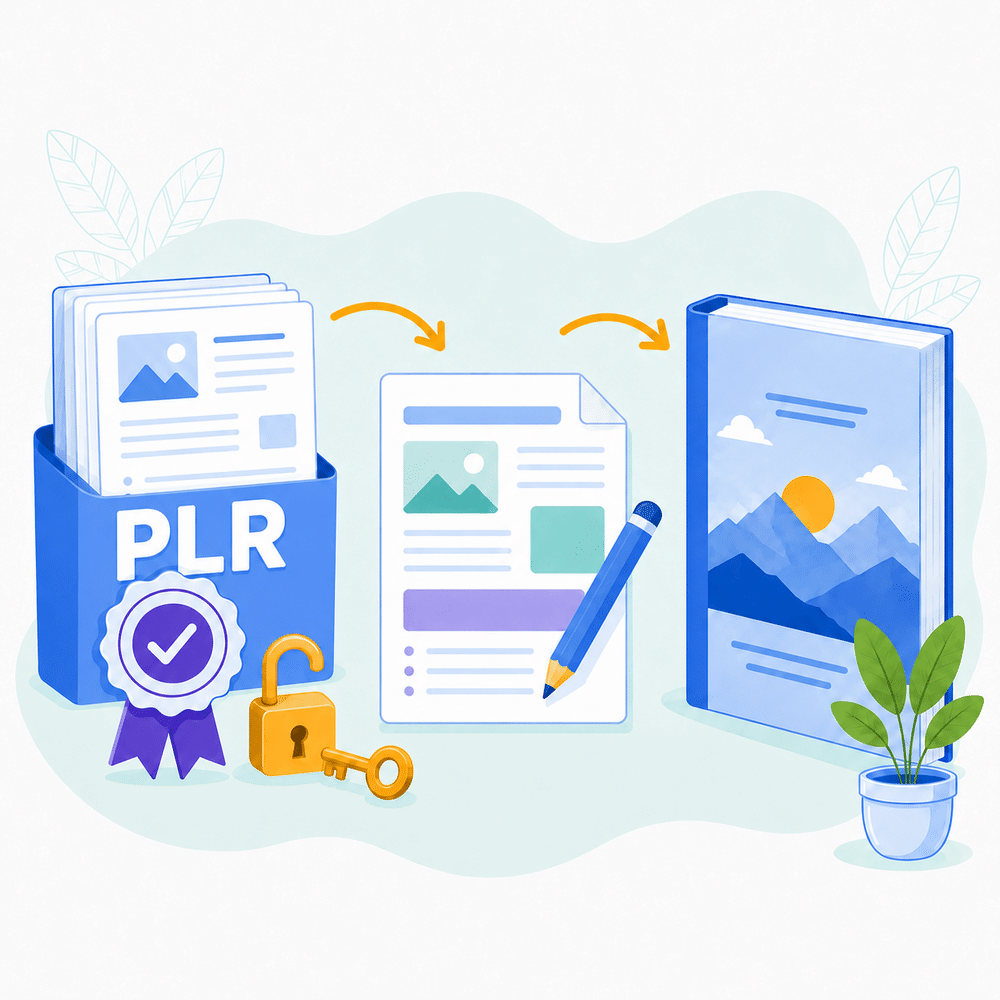
Most importantly, don't simply add your name and a new cover to the same generic book everyone else received. Use the PLR as raw material. You might:
- Narrow the content for a more specific audience
- Update statistics, links, examples and recommendations
- Reorganize or combine sections to create a better process
- Add your own stories, opinions, screenshots or case studies
- Remove weak or irrelevant material
- Create new worksheets, checklists or action steps
#7: Hire a Writer
There's always the option of hiring a professional writer. Fiverr, Upwork and other freelance marketplaces allow writers to offer services to write an ebook for you. You may also find specialists through referrals or professional groups.
Before hiring anyone, request several relevant samples and check references or customer feedback. A writer who creates excellent memoirs may not be the right person for a concise, instructional ebook in your niche.
Give prospective writers a clear project description that includes the audience, purpose, approximate length, tone, chapter outline, examples and source material. The more direction you provide, the less time the writer must spend guessing what you want—and the easier it will be to compare proposals.
For a larger project, consider paying for the first chapter or section before commissioning the entire book. Agree in advance on what happens if:
- The sample doesn't meet the requirements
- How many revisions are included
- Who owns the completed work
- Whether the writer may use any portion in a portfolio
You may need more than one freelancer. Some writers don't provide cover design, interior formatting or publishing assistance. Depending on the project, your small production team might include someone to:
- Research and write the book
- Edit or proofread the manuscript
- Design the cover and interior
- Format the finished book for the required file types
You can also reduce the writing cost by doing some of the preparation yourself. If you provide a strong outline, research, examples and recorded explanations, the writer can concentrate on shaping the material rather than developing the entire project from nothing.
However, don't assume it'll cost less to write an ebook yourself and then have a professional edit it. Copy editing is often more time-consuming than writing (read: more expensive). Think of it this way, building a house often takes less time than doing numerous repairs because you have to identify them, figure out how to fix them, buy the materials, spend extra time when one issue leads to yet another problem and so on.
Your Ebook Does Not Have to Look Like a Traditional Book
A useful ebook doesn't always require long chapters and thousands of words. Depending on the topic and audience, you might create:
- A step-by-step action guide
- A workbook with brief instructions
- A collection of checklists
- A visual tutorial with screenshots
- A resource guide
- A question-and-answer book
- A short plan or challenge
Choose the format that delivers the promised result most clearly. Readers are not paying you by the word. They are paying for useful information that saves time, answers a question, teaches a skill or helps them accomplish something.
Choose the Method That Helps You Finish
You can also combine several of these approaches. Interview an expert, add material from your blog, speak the missing chapters and use AI to help organize everything. Or begin with a workshop transcript, hire an editor and use Designrr or Canva to create the finished design.
The method matters less than the result: an accurate, useful ebook created for a specific audience and purpose.
Have questions about creating ebooks without writing? Talk to me below!